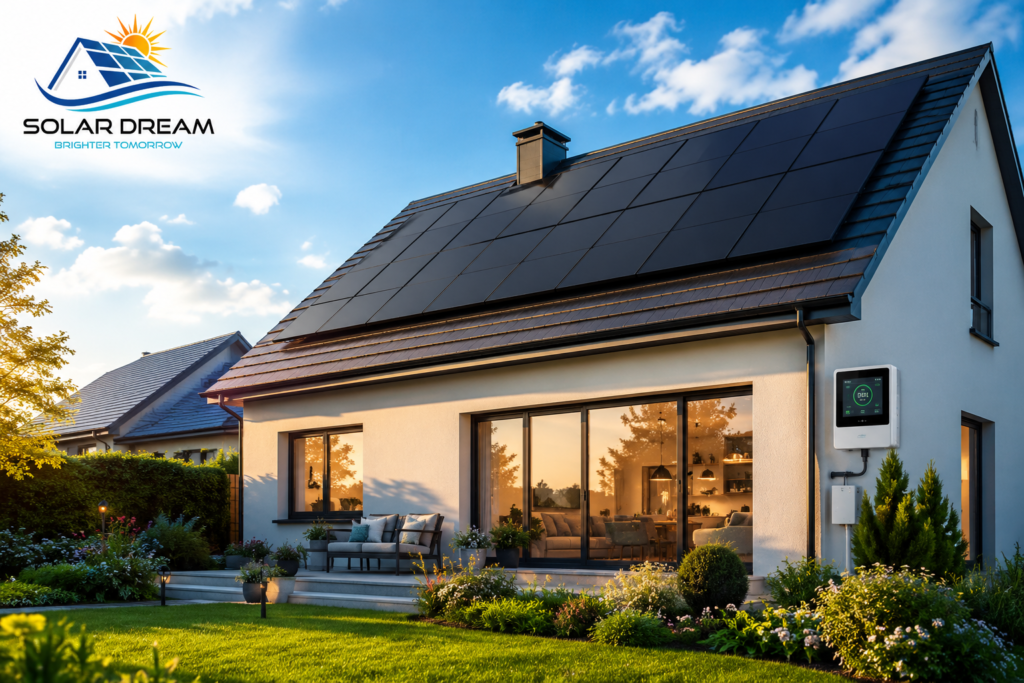
Our group of experts at Solar Dream has been actively committing to the idea of using the amazing power of the sun to help businesses and homeowners save money.
A Look into the Past
It is not new to use the energy of the sun. Even in the 7th century, human beings employed the use of magnifying glasses to concentrate sunlight and initiate fires. Greeks and Romans used burnishing mirrors in their religious practices and in the 6th century A.D., homes started to be equipped with sun rooms. The Justinian Code even used to set rights to sun so that every person could have equal access to sunlight. Early solar development was more a heat production and passive solar design, and how this affected the buildings orientation, location of windows, and ways to retain heat.
It was only in 1839 when the French physicist Edmond Becquerel made what was the first real breakthrough in solar electricity, discovering a phenomenon, the photovoltaic effect, whereby voltage is produced when light strikes certain materials. Charles Fritts would later make the first solid-state photovoltaic cell by applying a thin layer of gold to selenium. There was the first photoelectric cell invented by a Russian physicist Aleksandr Stoletov in 1888 and the first observation of photoelectric effect done by Heinrich Hertz in 1887. This preconditioned solar heaters and the first viable solar equipment.
The Domination of Modern Solar Cells
In 1954, Bell Labs developed the first useful solar cell, with the main purpose of operating satellites. These first solar panels were initially expensive and very inefficient, and were restricted to niche uses. In the long run, the strategy of innovation became more efficient and cost-reducing. The oil crisis of the 1970s drove the focus towards renewable energy, thus increasing the use of solar in residential and commercial settings.
In 1905, Albert Einstein published his study of the photoelectric effect, thus becoming the first winner of the Nobel Prize in 1921, which became the theoretical basis of solar electricity. Subsequent members of humanity, such as William J. Bailey in his Copper Collector (1908) and Russell Ohl in his 1946 patent on junction semiconductor breakthroughs, led the way towards the development of high-performance solar cells. By the 1980s corporations such as ARCO Solar were commercially manufacturing megawatt-scale solar modules and massive solar power plants were built in the United States.
Solar PV in the Present Day
Solar technology has emerged as a force throughout the world today. Solar panels have become more efficient, durable and are more attractive than ever. Prices have been reduced drastically and it has become economical to install solar systems in businesses, households and even government structures.
Modern solutions include:
- Storage solar panel and battery provisions.
- Installations of Solar panels on flat roofs or outbuildings.
- Garages and sheds with light weight solar panels.
- Solar inverters UK to maximise energy efficiency.
Each installation does not only cut down energy bills but also carbon footprints, which helps in supporting sustainability and corporate ESG objectives.
A Bright Future
The coming 15 years is a promise of transformational change. Solar power will also be the major component of competitive, resilient business practises. On-site solar will continue to gain popularity in companies as it:
- Become energy dependent.
- Protection against grid outages.
- Reduce operational costs
- Enhance brand reputation
We assist companies at Solar Dream to manoeuvre in this changing environment. We have trained and professional team who install and design solar PV solutions that are cost effective and help future proof operations in the fast evolving energy economy.
Solar energy has evolved, it does not start with the primitive sunrooms but rather advanced with the high efficiency panels. By adopting solar today, companies and residential customers will be able to benefit by having access to sustainable, affordable, and dependable energy in the years to come.
FAQs
Solar energy started with passive designs like sunrooms and mirrors in ancient civilizations. The photovoltaic effect was discovered in 1839, laying the foundation for modern solar electricity.
Bell Labs created the first practical solar cell in 1954, initially for satellites. Efficiency improved over decades, and solar became widely adopted in commercial and residential applications.
Today’s solar panels are efficient, durable, and cost-effective. Combined with battery storage and inverters, they reduce energy bills, carbon footprints, and support ESG goals for businesses.