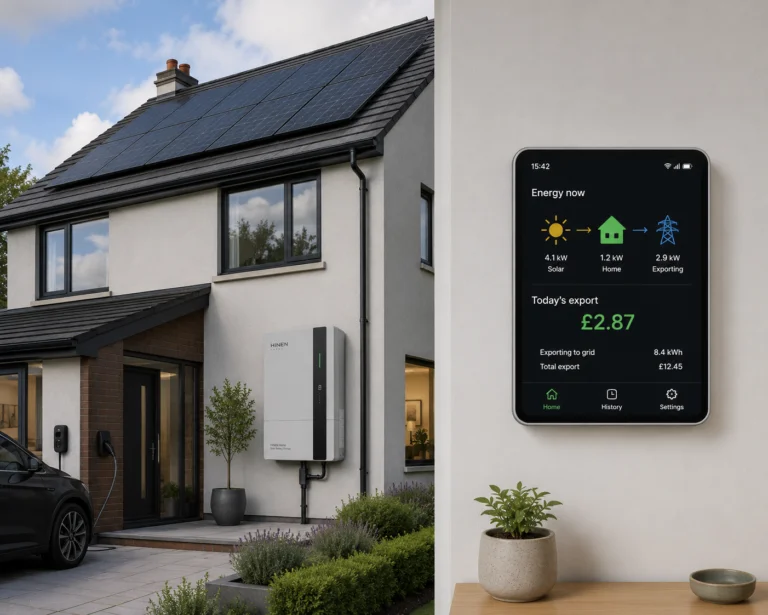
Smart Export Guarantee UK: How to Get Paid for Your Solar Energy
If you have solar panels installed on your UK home, or you are considering getting them, there is a valuable opportunity to earn money from the electricity you do not use. The Smart Export Guarantee, or SEG, is a government-backed scheme that pays you for every unit of excess solar energy you export back to the National Grid.
In this guide, we explain exactly how the Smart Export Guarantee works, how much you can earn, and how Solar Dream can help you maximise your solar income.
What Is the Smart Export Guarantee?
The Smart Export Guarantee, launched in January 2020, replaced the earlier Feed-in Tariff scheme. Under the SEG, energy suppliers with more than 150,000 domestic customers are required to offer export tariffs to households with solar panels. This means you get paid for every kilowatt-hour of electricity your solar panels generate that you do not use yourself and export back to the grid.
The scheme is designed to encourage renewable energy generation and make solar panels even more financially attractive for UK homeowners. Unlike the old Feed-in Tariff, the SEG is paid only for what you export, not for what you generate. This makes it essential to use as much of your own solar energy as possible and export the surplus.
Who Is Eligible for the SEG?
To qualify for the Smart Export Guarantee, you must meet the following criteria:
- Solar panel installation — your system must be installed by an MCS-certified installer like Solar Dream
- System capacity — your installation must be 5 megawatts or less, which covers all domestic solar panel systems
- Smart meter — you need a smart meter that can measure your export in half-hourly intervals
- SEG licence — the energy supplier you choose must hold an SEG licence from Ofgem
Solar Dream installs all our solar panel systems to MCS standards, so every installation is SEG eligible from day one.
How Much Can You Earn?
The amount you earn depends on your export tariff rate and how much excess electricity you export. Export tariff rates vary between energy suppliers. Some of the current rates include:
- Octopus Energy Outgoing Fixed — 15 pence per kWh
- E.On Next Export — 16.5 pence per kWh
- British Gas Export & Plus — 15 pence per kWh
- OVO Energy SEG Tariff — 4 pence per kWh
A typical 4kW solar panel system in the UK generates around 3,400 kWh per year. If you use 50 per cent of this energy in your home and export the remaining 50 per cent at 15p per kWh, you would earn approximately £255 per year from the SEG alone. This is on top of the savings on your electricity bills.
With a solar battery storage system, you can store excess energy during the day and use it in the evening, reducing what you export. This means less SEG income but far greater savings on your bills because the energy you store replaces electricity you would otherwise buy at retail prices of 24p to 30p per kWh.
How to Choose the Best SEG Tariff
Choosing the right SEG tariff is important to maximise your solar income. Here are some factors to consider:
- Export rate — compare rates per kWh across suppliers. Higher rates mean more income
- Deemed vs metered export — deemed export assumes a fixed percentage, while metered export measures exactly what you send back. Metered is almost always better
- Length of contract — some tariffs lock you in for 12 months, others are flexible
- Exit fees — check if there are penalties for switching supplier
- Smart meter compatibility — ensure your supplier supports your smart meter model
At Solar Dream, we guide our customers through the SEG process, helping you understand which tariffs offer the best value for your specific installation and energy usage pattern.
SEG vs Feed-in Tariff: What Is the Difference?
The old Feed-in Tariff paid you for every unit of electricity your panels generated, plus an additional payment for what you exported. The SEG pays only for what you export. This means you benefit most by using your solar energy during the day and exporting only what you cannot use.
If you already have a Feed-in Tariff from an earlier installation, you can keep it until it ends. You cannot claim both FiT and SEG for the same system. New installations from 2020 onwards are eligible only for the SEG.
How Solar Dream Helps You Maximise Solar Income
At Solar Dream, we do not just install solar panels. We design complete solar energy systems that maximise your return on investment. Our approach includes:
- Right-sized systems — we size your system to match your household energy usage, so you export less and save more
- Battery storage recommendations — we advise on whether a solar battery is right for your home to increase self-consumption
- SEG registration support — we help you register for the Smart Export Guarantee and choose the best tariff
- MCS certification — every Solar Dream installation is MCS certified, ensuring SEG eligibility
- Smart meter integration — we ensure your system works seamlessly with smart metering for accurate export measurement
Solar Panels and Batteries: The Smart Export Strategy
The best financial strategy for solar panel owners is to maximise self-consumption. Every unit of solar energy you use in your home saves you the retail cost of electricity, which is typically 24p to 30p per kWh. Exporting at 15p per kWh is good, but using that energy yourself is almost twice as valuable.
This is where solar battery storage makes financial sense. A battery stores your excess solar energy during the day and releases it in the evening when your panels are not generating. This can increase your self-consumption from 40 per cent to over 80 per cent, dramatically reducing your electricity bills while still earning SEG income on what little you export.
Is the Smart Export Guarantee Worth It?
Absolutely. The Smart Export Guarantee adds an income stream to your solar panel investment, reducing your payback period and increasing your overall return. Even at lower tariff rates, the SEG provides a meaningful financial benefit on top of your energy bill savings.
With electricity prices remaining high in the UK, solar panels combined with the SEG offer one of the best returns on investment available to homeowners. A well-designed solar system can pay for itself in 6 to 10 years while continuing to generate free electricity and export income for 25 years or more.
Get Started With Solar Dream Today
Ready to start earning from your solar panels? Contact Solar Dream for a free consultation and quote. We design and install MCS-certified solar panel systems across the UK, and we guide you through every step of the process — from installation to SEG registration.
Generate your own electricity, reduce your bills, and earn money from the energy you do not use. That is the power of solar with Solar Dream.
FAQs
Yes, most SEG tariffs require a smart meter to measure your export accurately. Some suppliers offer deemed export rates if you do not have a smart meter, but these are typically lower. Solar Dream can advise on smart meter installation compatibility.
Yes, you can switch your SEG tariff, though some suppliers have minimum contract periods of 12 months. Check for exit fees before switching. We recommend reviewing your tariff annually to ensure you are getting the best rate.
Your smart meter measures your export in half-hourly intervals and sends the data to your energy supplier. You are paid based on the exact amount of electricity you export, or in some cases a deemed export percentage if you do not have a smart meter.
SEG rates are set by individual energy suppliers and can change. Suppliers must publish their rates and any changes. It is worth checking regularly to ensure you are on the best available tariff for your location and system.
For most households, SEG income is tax-free. The government introduced a tax exemption for income from domestic solar exports, recognising it as a green incentive. You should consult a tax professional for advice specific to your situation.