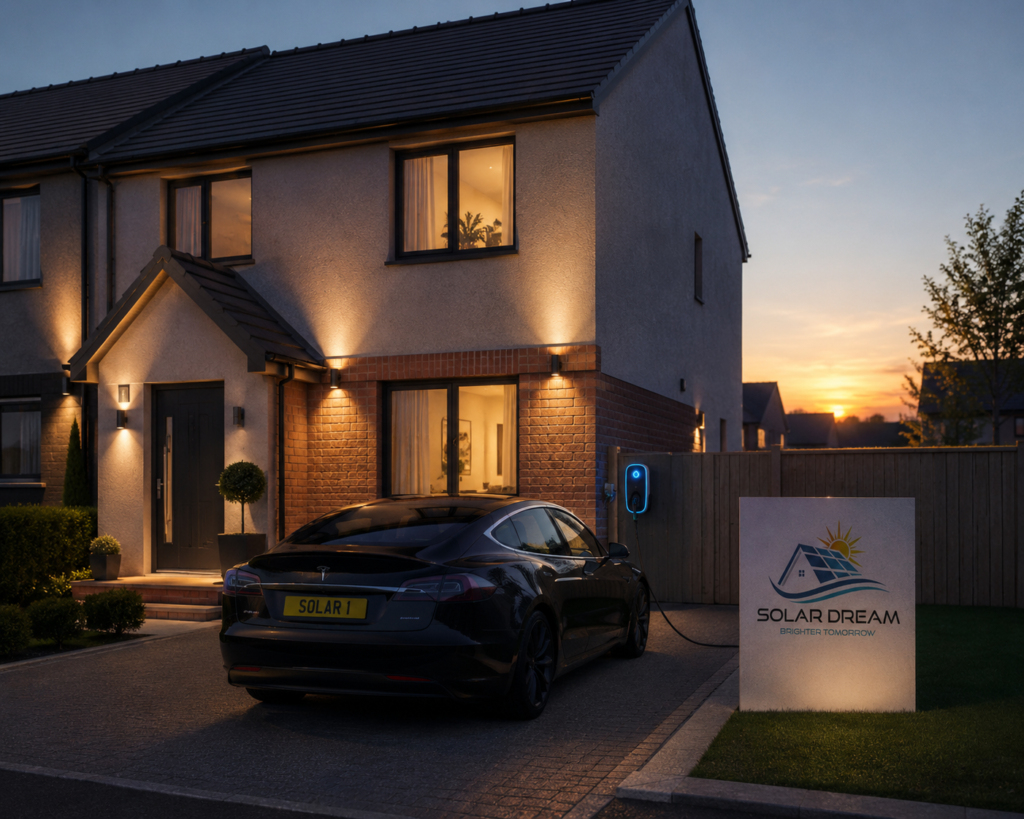
The shift to electric vehicles (EVs) is accelerating across the United Kingdom. With petrol prices climbing and government incentives supporting low-emission transport, more homeowners than ever are making the switch. But owning an electric car is only half the story — you need a reliable, efficient charging solution at home. That is where Solar Dream comes in. As a trusted UK-based installer, we specialise in domestic EV charging point installation that is fast, professional, and fully compliant with UK regulations.
Whether you already drive an electric vehicle or are planning to buy one soon, having a dedicated home charger transforms the ownership experience. No more hunting for public charging stations or waiting in queues. You simply park, plug in, and wake up to a full battery every morning. In this guide, we walk you through everything you need to know about EV charger installation in the UK — from costs and grants to charger types and the installation process itself.
Why Install a Home EV Charging Point?
Home charging is the most convenient and cost-effective way to power your electric vehicle. According to industry data, over 80 per cent of EV charging happens at home. With a dedicated wallbox charger, you can charge your car overnight when electricity rates are lowest, saving significantly compared to public rapid chargers.
- Convenience — Charge while you sleep; no need to detour to a petrol station.
- Lower running costs — Home electricity is cheaper than public charging networks.
- Faster charging — A 7kW home charger adds around 30 miles of range per hour.
- Increased property value — A dedicated EV charging point is a desirable feature for future buyers.
- Smart charging features — Schedule charging during off-peak hours and track your energy usage via an app.
Types of Home EV Chargers Available in the UK
When it comes to home EV charging, there are two main categories: tethered and untethered (socket-only) chargers. Tethered units come with a cable permanently attached, while untethered units have a standard Type 2 socket that accepts your own cable. Both options are available as smart chargers, which are now mandatory under UK regulations for new installations.
Tethered EV Chargers
Tethered chargers are the most popular choice for homeowners. They offer grab-and-go convenience — simply unplug the attached cable and connect it to your car. Popular models include the Zappi, Wallbox Pulsar Max, and the Ohme Home Pro. These chargers typically deliver 7kW (32 amps) of power, which is sufficient for overnight charging for most EVs on the market today.
Untethered EV Chargers
Untethered chargers feature a built-in socket (usually Type 2) and require you to use your own charging cable. They are slightly more future-proof because you can replace the cable if it gets damaged, and they work with both Type 1 and Type 2 connectors using the appropriate cable. However, they require you to store and handle your cable each time you charge, which some users find less convenient.
Smart Chargers
Since June 2022, all new home EV charger installations in Great Britain must have smart functionality. Smart chargers can connect to your home Wi-Fi, communicate with your energy supplier, and automatically schedule charging during off-peak hours. They also enable load balancing, which prevents your home’s electrical system from being overloaded. Solar Dream only installs OZEV-approved smart chargers that meet the latest UK standards.
The EV Charger Installation Process with Solar Dream
We believe in making EV charger installation straightforward and stress-free. Here is a step-by-step breakdown of what you can expect when you choose Solar Dream.
- Step 1: Free Site Survey — Our qualified electrician visits your property to assess your electrical infrastructure, parking arrangement, and preferred charger location. We check your consumer unit capacity and recommend the best solution.
- Step 2: Charger Selection — Based on your needs and budget, we help you choose the right charger from our range of OZEV-approved models. We discuss tethered vs untethered, power output, and smart features.
- Step 3: Quotation — You receive a clear, no-obligation quote with no hidden fees. We price-match like-for-like installations and offer flexible finance options.
- Step 4: Installation Day — Our certified installation team arrives at the agreed time. A standard domestic installation takes 2-4 hours. We handle everything from mounting the unit to connecting the circuit and configuring the smart app.
- Step 5: Testing and Handover — We test the charger thoroughly, show you how to use the app and smart features, and provide all certification documents including your Part P compliance certificate.
How Much Does EV Charger Installation Cost in the UK?
One of the most common questions we hear is about cost. The price of a home EV charging point installation varies depending on the charger model, your property type, and any additional electrical work required. On average, a standard installation of a 7kW smart charger costs between GBP 800 and GBP 1,300 fully installed. This includes the charger unit, installation labour, and certification.
Factors that can affect the cost include the distance from your consumer unit to the charging location, whether you need a dedicated earth rod or PEN fault protection device, and any cable routing through walls or trenches across driveways. Solar Dream provides transparent pricing — the price we quote is the price you pay.
If you are looking to get a quote for EV charger installation, contact our team and we will be happy to provide a personalised estimate.
Do You Need Solar Panels for an EV Charger?
A common misconception is that you must have solar panels to install an EV charger. This is not true. EV chargers work perfectly well with grid electricity, and most UK homeowners with EV chargers do not have solar panels. However, combining an EV charger with a solar PV system and battery storage can significantly reduce your charging costs and carbon footprint.
When your solar panels generate excess electricity during the day, instead of exporting it to the grid, you can use it to charge your electric car for free. Solar-compatible chargers like the Zappi can automatically detect surplus solar generation and divert it to your EV. This is known as solar-compatible or solar-diverts charging, and it is one of the most efficient ways to power your vehicle.
If you are interested in a complete home energy solution, Solar Dream offers integrated packages combining solar panel installation, battery storage, and EV charging. Speak to our team about designing a system tailored to your home and lifestyle.
Are There Government Grants for EV Chargers?
The UK government has introduced several schemes to support EV charger adoption over the years. While the Electric Vehicle Homecharge Scheme (EVHS) for homeowners ended in April 2022, there are still grants available for certain groups.
- Workplace Charging Scheme (WCS) — Provides grant funding for businesses, charities, and public sector organisations to install EV charge points for staff and fleets.
- EV Chargepoint Grant for Flat Owners and Renters — Available for people living in flats or rented accommodation who cannot install a dedicated charger.
- Local Authority Schemes — Some councils offer their own grant programmes for residents. Check your local authority website for details.
- Reduced VAT — The installation of a home EV charger qualifies for 5 per cent VAT on the labour and equipment, which is significantly lower than the standard 20 per cent rate.
At Solar Dream, we stay up to date with all available grants and incentives. We will advise you on any schemes you may qualify for and handle the paperwork where applicable.
Can You Install an EV Charger Yourself?
We strongly advise against DIY installation of EV chargers. In the UK, EV charger installation is notifiable electrical work under Part P of the Building Regulations. This means it must be carried out by a qualified, competent person registered with a government-approved scheme such as NAPIT or NICEIC.
Attempting to install an EV charger yourself carries several risks:
- Safety hazards from high-voltage electrical work
- Non-compliance with UK Building Regulations and IET Wiring Regulations (BS 7671)
- Invalidation of your home insurance
- Loss of manufacturer warranty on the charger unit
- Risk of voiding your electric car’s warranty if damage occurs
A professional installation by Solar Dream includes full certification, Part P compliance, a manufacturer-backed warranty, and peace of mind that your charging system is safe and reliable. Contact our team today to book your installation.
Which EV Charger Is Best for Home Use?
The best home EV charger depends on your specific needs, but we generally recommend a 7kW smart charger with OZEV approval. Here are our top recommendations:
- Zappi (by myenergi) — The best all-rounder. Solar-compatible with built-in ECO modes that automatically use surplus solar energy to charge your EV. Excellent app and UK support.
- Ohme Home Pro — The best for smart tariffs. Integrates seamlessly with Octopus Agile, Go, and Intelligent Octopus tariffs. Slim design and reliable performance.
- Wallbox Pulsar Max — Compact and powerful. Features Power Boost technology for load balancing. Great for homes with limited space near the meter.
- Hypervolt Home 3 — Sleek British design with a tethered or untethered option. Built-in PEN fault protection and Wi-Fi connectivity.
Solar Dream can help you choose the right model based on your vehicle, energy tariff, and budget. We offer expert advice and professional installation for all of these leading brands.
How Long Does EV Charger Installation Take?
A standard domestic EV charger installation typically takes between 2 and 4 hours. This assumes your consumer unit is reasonably close to the charging location and does not require significant groundwork. For more complex installations — such as running cable through multiple floors, digging a trench across a driveway, or upgrading your consumer unit — the job may take longer and could require a second visit.
During your free site survey, our electrician will provide a realistic time estimate. We always aim to complete the installation in a single visit so you can start charging your vehicle as soon as possible.
Why Solar Dream Is the Right Choice for Your EV Charger Installation
Solar Dream is more than just an EV charger installer. We are a full-service renewable energy company based in the UK, with years of experience in solar PV, battery storage, EV charging points, electric boilers, wind turbines, CCTV systems, and pigeon proofing services. Our team of qualified electricians and NAPIT-approved installers ensures every job is completed to the highest standard.
We pride ourselves on transparent pricing, excellent customer service, and a commitment to helping UK homeowners reduce their carbon footprint. With Solar Dream, you are not just getting a charging point — you are investing in a cleaner, more sustainable future.
Ready to make the switch? Request your free EV charger quote online or call our friendly team to book your free site survey today.
FAQs
The typical cost of a professionally installed home EV charger in the UK ranges from GBP 800 to GBP 1,300. This includes the charger unit, installation labour, Part P certification, and VAT at the reduced 5 per cent rate. The final price depends on the charger model, the distance from your consumer unit, and any additional electrical work required. Solar Dream offers transparent pricing with no hidden fees.
No. EV charger installation is notifiable electrical work under Part P of the UK Building Regulations. It must be carried out by a qualified, competent person registered with a government-approved scheme. DIY installation is unsafe and can invalidate your home insurance, charger warranty, and vehicle warranty. Always use a certified professional like Solar Dream.
No, you do not need solar panels to install an EV charger. Home chargers work perfectly well using mains electricity. However, pairing an EV charger with solar panels and battery storage can reduce your charging costs significantly by using free solar energy to power your vehicle. Solar Dream offers integrated solar and EV charging solutions.
A standard domestic EV charger installation typically takes 2 to 4 hours. More complex installations -- such as those requiring cable routing through multiple floors or trenching across driveways -- may take longer. Solar Dream provides a time estimate during your free site survey and aims to complete the job in a single visit.
The Electric Vehicle Homecharge Scheme (EVHS) for homeowners ended in April 2022. However, grants are still available through the Workplace Charging Scheme (WCS) for businesses, the EV Chargepoint Grant for flat owners and renters, and various local authority schemes. Installations also benefit from a reduced 5 per cent VAT rate. Solar Dream can advise on any schemes you may qualify for.