If you are considering solar panels for your home, you have probably spent most of your time thinking about the panels themselves. But there is another component that is just as important, if not more so. The solar inverter is the brain of your entire solar power system. It converts the direct current electricity your panels generate into the alternating current electricity your home uses. Without a quality inverter, even the best solar panels will underperform. Choosing the right inverter is one of the most important decisions you will make when designing your solar system.
At Solar Dream, we install solar panel systems across Norfolk, Suffolk, and East Anglia with a range of inverter options to suit different homes, budgets, and energy goals. We work with leading brands including Hinen, Solis, and GivEnergy to deliver reliable, high-performance inverter solutions. Here is everything you need to know to choose the right inverter for your home.
What Does a Solar Inverter Actually Do?
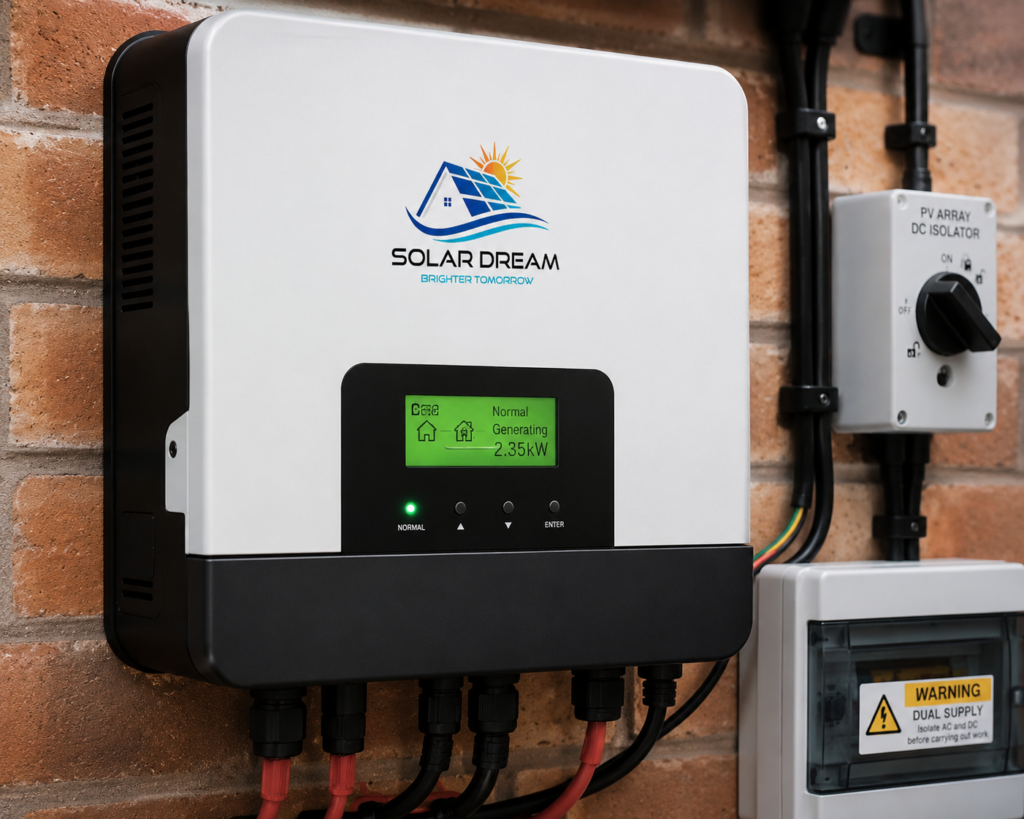
Your solar panels generate direct current electricity when sunlight hits the photovoltaic cells. Your home and the national grid operate on alternating current electricity. The inverter’s primary job is to convert DC to AC so the electricity your panels produce can actually be used in your home. But modern inverters do much more than that. They monitor your system’s performance, optimise energy production, provide safety features like rapid shutdown, and communicate data to you through a monitoring app or web portal.
Inverters also manage the interaction between your solar panels, your home’s electrical system, the grid, and any battery storage you may have. An intelligent inverter can decide whether to send power to your home, charge your battery, or export to the grid based on real-time conditions and your preferences. This intelligence is what turns a basic solar setup into a truly smart home energy system. Without a good inverter, you are missing out on the full potential of your solar investment.
The Main Types of Solar Inverters
String Inverters
String inverters are the most common and cost-effective type of solar inverter. Your solar panels are connected in a series string, and the combined DC electricity flows to a single inverter unit, usually installed in your loft, garage, or on an external wall. String inverters are reliable, well proven, and typically come with 5 to 12 year warranties that can be extended. They work best when all your panels receive similar sunlight, meaning they are ideal for roofs with a single orientation and no shading issues. For many UK homes with simple roof layouts, a string inverter offers the best balance of performance and value.
Microinverters
Microinverters are small units attached to each individual solar panel. Instead of one central inverter, you have many small ones working independently. This means each panel operates at its own optimal level, regardless of what the other panels are doing. Microinverters are excellent for roofs with multiple orientations, shading from chimneys or trees, or where panels are installed on different roof faces. They also include panel-level monitoring, so you can see exactly how each panel is performing. The downside is higher upfront cost compared to string inverters, but the performance gain on complex roofs often justifies the extra expense.
Hybrid Inverters
Hybrid inverters combine a standard solar inverter with a battery inverter in one unit. If you are planning to add battery storage now or in the future, a hybrid inverter is a smart choice. It manages both your solar panels and your battery, simplifying the system and reducing the number of components. Hybrid inverters, such as the Hinen range we install at Solar Dream, are increasingly popular because they offer flexibility to add battery storage later without needing a separate inverter. This future-proofing makes them a strong choice for homeowners who want to start with solar and add battery storage down the line.
Power Optimisers
Power optimisers are a middle ground between string inverters and microinverters. They are attached to each panel and optimise the DC output before sending it to a central string inverter. They offer many of the benefits of microinverters, such as panel-level optimisation and performance monitoring, but at a lower cost. They are a good choice for roofs with some shading or multiple orientations where a standard string inverter would lose performance. Power optimisers give you a useful upgrade over a basic string inverter without the full cost of microinverters.
Which Inverter Is Right for Your Home?
The best inverter for your home depends on your roof characteristics, your budget, and whether you plan to add battery storage. For a simple south-facing roof with no shading, a high-quality string inverter offers the best value for money. If your roof has panels on multiple orientations or suffers from shading, microinverters or power optimisers will maximise your energy production. If you are planning battery storage now or within the next few years, a hybrid inverter is the most future-proof choice.
At Solar Dream, we do not believe in one-size-fits-all solutions. We assess your specific situation and recommend the inverter type and brand that will give you the best performance and return on investment. We explain the options clearly so you can make an informed decision. Our team has installed every type of inverter across hundreds of homes in Norfolk and East Anglia, so we know what works best in local conditions. We take the time to understand your energy goals and tailor our recommendation accordingly.
Inverter Efficiency and What It Means for You
Inverter efficiency is measured by how effectively it converts DC to AC electricity. Top-quality inverters achieve efficiency ratings of 96 to 98 per cent. That means only two to four per cent of the energy is lost in the conversion process. While that might sound small, over the 25-year lifespan of your solar system, every percentage point of efficiency makes a real difference to your total energy production and savings. Always choose inverters from reputable manufacturers that publish honest efficiency data. A high-efficiency inverter can pay for itself over time through increased energy capture.
Inverter Warranties and Lifespan
Solar inverters typically last 10 to 15 years, which is shorter than the 25 to 30 year lifespan of solar panels. This means you should expect to replace your inverter at least once during the life of your solar system. Most manufacturers offer a standard 5 to 12 year warranty, with optional extensions available. When budgeting for your solar system, it is wise to factor in a future inverter replacement. At Solar Dream, we use inverters from trusted brands with strong warranty terms and UK-based support networks. We also offer advice on extended warranties when they represent good value for money.
Monitoring and Smart Features
Modern inverters come with built-in monitoring capabilities that let you track your solar system’s performance from your phone or computer. You can see real-time generation, consumption, battery status, and export data. Some inverters offer smart features like time-of-use optimisation, where the system automatically charges your battery during cheap overnight tariffs and discharges during peak-rate periods. These features can significantly increase your savings, especially if you are on a time-of-use electricity tariff like Economy 7 or Octopus Flux. The ability to see exactly what your system is doing gives you confidence that your investment is performing as expected and lets you spot any issues early.
Inverter Installation Considerations
Inverters need to be installed in a location that stays cool and well ventilated, as heat reduces efficiency and can shorten the unit’s lifespan. Common locations include lofts, garages, utility rooms, or on an external wall under a protective cover. The inverter should be accessible for maintenance and close to your consumer unit to minimise cable runs. Our installers at Solar Dream take all these factors into account when planning your system, ensuring the inverter is sited for optimal performance and longevity. A well-sited inverter can last years longer than one exposed to excessive heat or moisture, so getting the location right matters.
Inverter Costs in the UK
Inverter costs vary by type and brand. A good quality string inverter for a typical home costs between £500 and £1,200. Microinverters add roughly £100 to £200 per panel compared to a string inverter. Hybrid inverters capable of managing battery storage range from £1,000 to £2,000. Power optimisers add around £50 to £100 per panel. Remember that the inverter is a long-term investment, and choosing a cheaper, lower-quality unit can cost you more in lost generation and early replacement down the line. It is always worth paying a little more for a reliable brand with good UK support and proven performance in British weather conditions.
Get Expert Inverter Advice from Solar Dream
Choosing the right solar inverter is a technical decision that affects the performance, reliability, and longevity of your entire solar system. At Solar Dream, we have years of experience matching homes with the right inverter technology. We only install inverters from manufacturers with proven track records and strong UK support. Our team is always happy to explain the options and help you choose the best solution for your home and budget. We believe that an informed customer makes the best decision, and we take the time to make sure you understand your choices.
Visit our inverter and battery page to see the brands we work with, or contact us for a free, no-obligation consultation. We also offer solar PV installation and flexible finance options across Norfolk, Suffolk, and East Anglia.
FAQs
A solar inverter converts the direct current electricity generated by your solar panels into alternating current electricity that your home and the national grid can use. It also monitors system performance and manages energy flows.
A string inverter connects all your solar panels in one series to a single unit. Microinverters are attached to each panel individually, allowing each panel to operate independently and perform better in shaded or multi-orientation roofs.
Most solar inverters last 10 to 15 years, which is shorter than solar panels. You should expect to replace the inverter at least once during your system's 25-year lifespan.
A hybrid inverter combines a standard solar inverter with a battery inverter in one unit, allowing you to manage both solar panels and battery storage from a single device. It is a future-proof choice if you plan to add batteries.
Yes, you need an inverter that is compatible with battery storage. A hybrid inverter handles both solar and battery functions, or you can add a separate AC-coupled battery inverter to an existing system.